
Our methodology
Mount AI: the climb from AI-curious to AI-capable.
A mental model for libraries to understand and implement artificial intelligence. Five levels, from Basecamp to Summit. Each one builds on the last, so the climb is steady and strategic: no leaping ahead, no leaving staff behind.

The climb
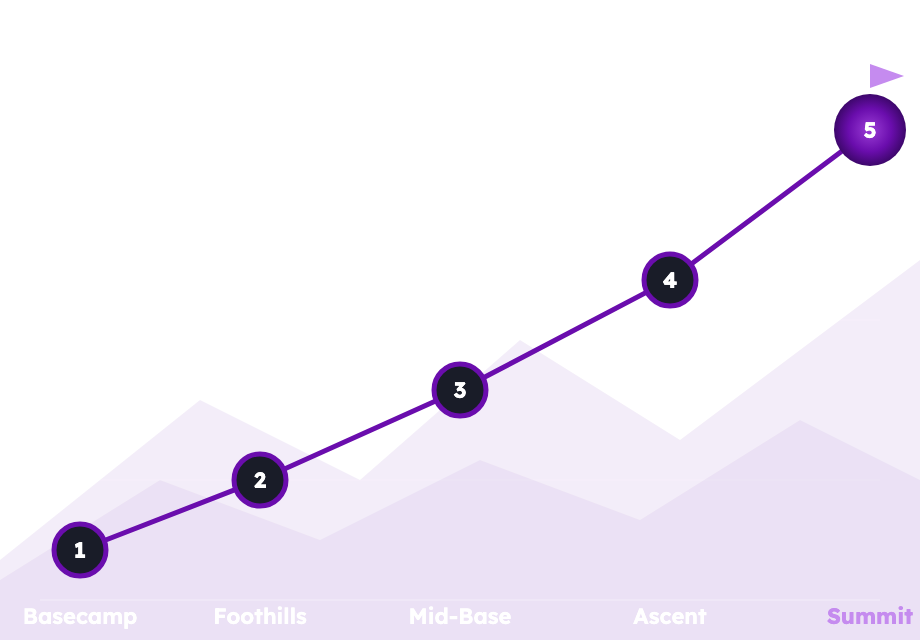
Five levels
Where is your library on the mountain?
Most libraries are somewhere between Basecamp and Mid-Base. Find the level that sounds like you and start there.
02
Experiment & define vision
Move from passive learning to low-risk experiments on internal tasks.
03
Staff training & community
Train the whole staff and start the conversation with the public.

Level 1 of 5
Level 1 · Basecamp
Explore & learn
This foundational stage is all about building awareness and demystifying AI. The goal is to cultivate curiosity and establish a baseline understanding of what AI is (and isn’t) without the pressure of implementation. It involves exploring basic concepts, learning key terminology, and observing how AI is already affecting the information landscape.
Suggested next steps
- Form an AI Explorers Group Assemble a small, voluntary group of staff from different departments to meet regularly, share interesting articles or tools, and discuss AI concepts in a low-pressure environment.
- Curate foundational resources Create a shared digital space (like a folder or a simple webpage) with introductory videos, articles, and glossaries about AI, tailored for library professionals.
- Host a “Show and Tell” Encourage staff to experiment with publicly available AI tools (like Gemini, Copilot or ChatGPT) for simple tasks and share their findings and impressions with the explorers group.
Level 2 · Foothills
Experiment & define vision
Here, the focus shifts from passive learning to active, low-risk experimentation. By testing AI tools on internal, non-public-facing tasks, the library can gain practical experience, identify potential benefits and challenges, and begin to envision how AI could align with its mission. This hands-on approach is crucial for developing an informed strategy and AI policy.
Suggested next steps
- Identify low-stakes use cases Choose simple administrative tasks to test AI on, such as summarizing meeting minutes, drafting internal announcements, or generating ideas for social media posts.
- Begin drafting a vision statement Start a collaborative document to answer the question: “How could AI help us better serve our community and fulfill our mission?” This is the first step toward a formal strategy.
- Experiment with small-scale staff training Develop a small-scale internal staff training for select team members to develop foundational AI skills and tools to build more institutional awareness.

Level 2 of 5

Level 3 of 5
Level 3 · Mid-Base
Staff training & community engagement
This level is about scaling up knowledge from the small explorer group to the entire staff and beginning the conversation with the public. Empowering staff with formal training ensures a consistent understanding and builds the confidence needed to eventually guide patrons. Initial community engagement focuses on education and dialogue, positioning the library as a trusted guide in this new technological space.
Suggested next steps
- Develop foundational AI literacy training Create a mandatory but accessible training module for all staff covering AI ethics, common tools, and how to talk about AI with patrons.
- Host a public “Intro to AI” workshop Organize a workshop for the community that explains AI in simple terms, demonstrates common tools, and discusses its societal impact.
- Create a patron-facing AI resource guide Develop a simple one-page handout or webpage listing trusted resources, definitions, and tips for patrons curious about AI.
Level 4 · Ascent
Run a pilot & refine AI guidelines
This is where the library formalizes its approach. A defined pilot project allows for testing a specific AI application in a controlled way to gather data on its effectiveness and impact. An advisory board brings in diverse community and expert perspectives, while formal policies create essential guardrails for the ethical and responsible use of AI, refining the initial strategy with practical experience.
Suggested next steps
- Define and launch a pilot project Select a single, measurable public-facing service to enhance with AI (e.g., using a chatbot for after-hours reference questions for one month) and define what success looks like.
- Establish an AI advisory board Invite a diverse group of community members, staff, and local tech or ethics experts to provide guidance on the library’s AI strategy, guidelines and policies.
- Draft an AI principles & ethics policy Using guidance from the Canadian Urban Libraries Council and other professional organizations, create a foundational document that outlines the library’s values and principles for using AI.

Level 4 of 5

Level 5 of 5
Level 5 · Summit
Operational excellence
At the summit, AI is no longer a special project but is thoughtfully integrated into the library’s standard operations. The organization has established processes, use guidelines, policies, and a culture of continuous learning to manage AI tools effectively. AI is used to enhance services, improve staff efficiency, and empower the community, all in alignment with the library’s core mission and values.
Suggested next steps
- Integrate the successful pilot If the pilot project was successful, develop a plan to make it a permanent, supported part of the library’s services.
- Establish a regular review cycle Create a formal process to periodically review the library’s AI tools, guidelines, policies, and their impact to ensure they remain effective and aligned with community needs and ethical standards.
- Develop advanced AI training Offer specialized training for staff in specific roles, such as using AI for collection development analysis, advanced reference services, or marketing.
Level 5 · Summit
Reach the summit by integrating AI to better serve your community.
We walk libraries up every level, from the first explorers group to a reviewed, running service.
On the climb
Libraries scaling Mount AI.



8in-house AI trainers6peer sessions2public programs
Level 3 · Train the trainer
A fully remote Train-the-Trainer pilot gave MPL eight in-house AI trainers, who went on to run six peer sessions and two public programs.
18AI leaders trained3training days4+staff roles
Level 3 · Staff training
A three-day program for librarians, IT, collections and admin staff trained 18 AI leaders to use AI in their everyday work.
Before working with ENGR Solutions, our library had no standardized approach to AI integration. Their comprehensive training program transformed our capabilities – not only did our staff’s comfort with AI tools increase significantly, but we’re now equipped to train others and serve our community better.
Andrea Cecchetto
Director, Service Excellence, Markham Public Library
Let’s talk
Not sure which level you’re at? We’ll tell you in 30 minutes.
A 30-minute call to talk through where your library is today. We listen, place you on the mountain, and follow up with a clear plan for the next level.